

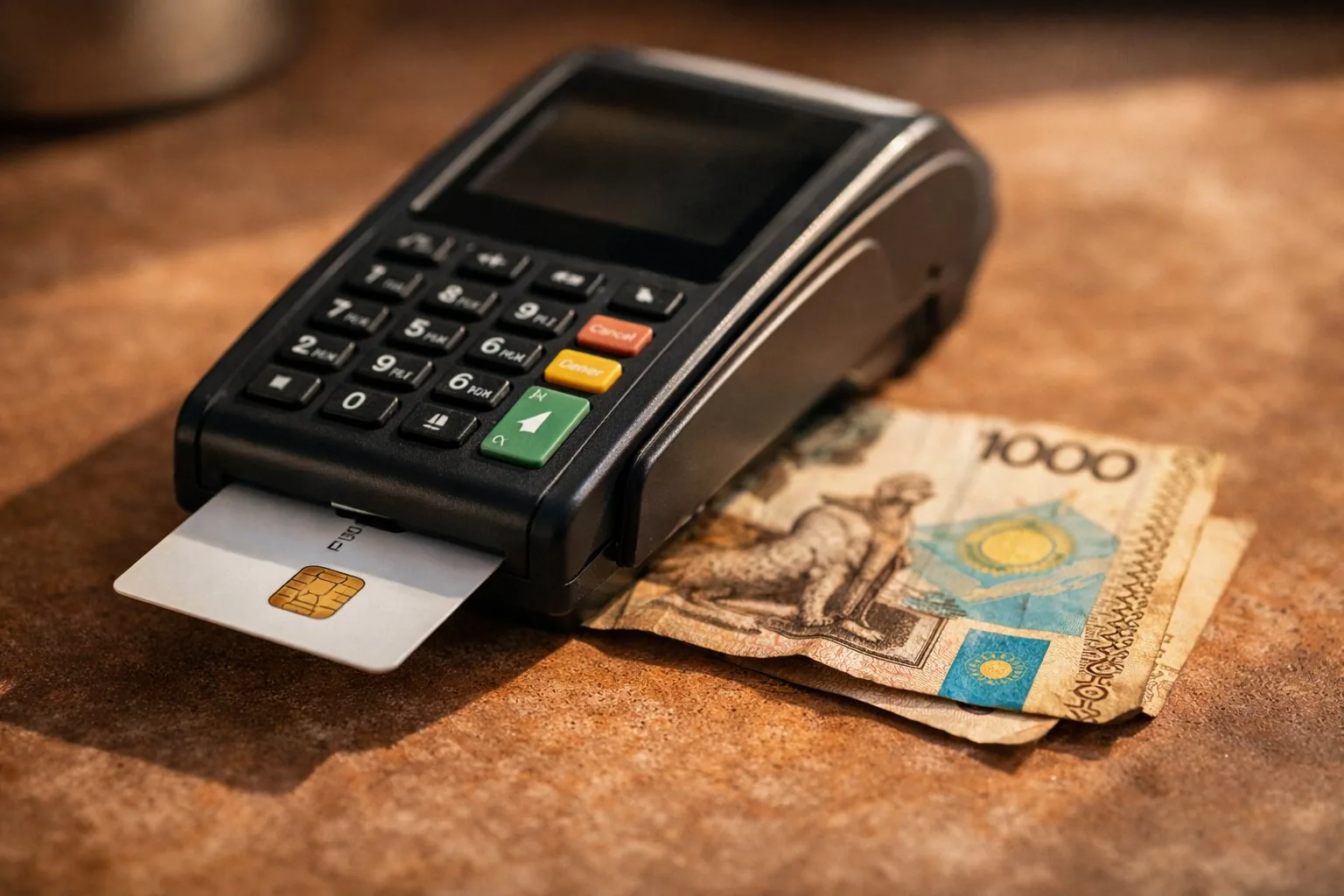
For January–May 2026, Kazakhstani citizens paid 73.5 trillion tenge using cards, with 87.6% of all card turnover being cashless — compared to 12.5% in 2016. Almost 79% of the cashless volume today goes through the internet and mobile apps, and the share of QR payments has grown from 2.8% to 10.8% over three years. Against this backdrop, accepting online payments has ceased to be a "nice option" for a website: if you can't pay here and now — by card, via Kaspi, or by QR — part of the revenue simply doesn't reach the cash register because the buyer goes where it's easier to pay.
West Star Ltd has been engaged in web development, 1C integrations, and payment automation for Kazakhstani businesses for over ten years, and during this time, we have connected almost all available payment gateways in the country to websites — from Kaspi Pay and Halyk ePay to Freedom Pay and Forte. Let's break it down without marketing: how online payment acceptance is structured in Kazakhstan in 2026, what the commission really consists of, how the integration of the payment page with the site and accounting looks, and where the pitfalls of this story are.
What is Included in Online Payment Acceptance and Who Provides It
First, it's worth distinguishing between two concepts that are often confused. Internet acquiring is a bank service that allows you to accept card payments on a website: the money from the buyer's card goes to your settlement account through the acquiring bank. A payment gateway or aggregator is a technical intermediary that provides several payment methods under one contract: cards, Apple Pay and Google Pay, QR, installment plans. For small businesses, the difference is simple: acquiring directly from the bank is usually cheaper in terms of rate, but takes longer to connect; an aggregator is more expensive but starts faster and covers all methods at once.
In Kazakhstan, the real choice of providers is not as large as it seems. Card acquiring and payment pages are offered by Halyk ePay, Kaspi Pay, Freedom Pay, ForteBank, and Bank CenterCredit; from aggregators and gateways, PayBox, TipTopPay, P-Pay, and a few other services operate in the market. The set of methods is roughly the same for everyone: bank cards, contactless payment through phone wallets, QR, and consumer installment plans — the latter is especially important for the average check, with Kaspi Red's "0-0-12" scheme long becoming a standard of customer expectations.
It is worth separately mentioning the change that reshaped the logic of QR payments in 2026. From July 7, the National Bank and the relevant agency began the phased launch of a single QR code, and from July 19, it was fully operational: now the buyer can pay with one QR at the checkout through any bank's app, not just the one whose code is pasted on the terminal. For businesses, this means that tying to one bank's ecosystem for QR is no longer necessary — and this should be considered when choosing how to accept online payments.
A typical mistake we regularly see with new clients looks like this: an online store connected only one method of payment convenient for the owner and considers the problem solved. In reality, each method cuts off its share of buyers — someone doesn't use a specific bank, someone doesn't have cash on the card but has an installment limit, someone only pays by QR. The narrower the set of methods, the more abandoned carts at the last step, and these losses are almost invisible in reports because the failed payment is not recorded anywhere. Therefore, the conversation about payment acceptance is always a conversation about a set of methods, not about one "main" gateway.
How Much It Costs and How to Connect Online Payment Acceptance
The main question is almost always about the commission, and here it's important to look not at one figure but at the structure. According to open comparisons as of mid-2026, internet acquiring by cards costs about 1.5–3% (Halyk Bank — up to 3%, Freedom Bank — about 2.5%, Forte's rate for foreign cards can reach up to 4%). QR is noticeably cheaper: 0.5% at Halyk, from 0.95% at Kaspi, about 1.3% under the interbank single QR scheme. Acquirer's own bank cards often cost from 0.4–0.8%. However, installment plans for the seller are the most expensive option: the seller's commission starts from 5% for three months and reaches 18–20% for twenty-four, so it is usually partially included in the price. All these rates are not fixed: they depend on turnover, business category, and specific contract conditions, so the provider's advertised figures should be double-checked in your commercial offer.
The connection process looks roughly the same for everyone. You need an IP or LLP account and an acquiring agreement with a bank or aggregator. After that, you receive a merchant identifier and API access keys, connect a payment page or widget on the site, set up receiving payment status notifications via webhooks, run test payments in the sandbox, and only then switch to combat mode. Connecting one provider takes 5–10 business days, and a full "cards plus Kaspi plus QR plus installment" complex takes two to four weeks, counting both the legal part and technical integration.
Technically, online payment acceptance rarely lives on its own. The payment makes sense to immediately link with accounting: automatically record the receipt in 1C, reconcile the statement with orders, generate a receipt, and, if necessary, launch repeat charges for subscriptions. In our practice, we bring working with providers into a separate layer — the so-called abstraction over payment systems — so that the store does not depend on one SDK and so that adding a second bank can be done without rewriting half the site. If you are only planning such a system, it is convenient to consider it as part of a general project on connecting payment acceptance and tickets, and the payment-accounting link as part of automation of calculations and accounting. For those who do not yet have a site, it is more logical to start one level higher — with choosing a way to create a site, and to lay the payment module immediately in the architecture, not attach it later.
The separate benefit of such an architecture is visible not on the connection day, but after a month of operation. When each payment automatically enters the accounting with a link to the order, the accountant does not have to manually reconcile the bank statement with hundreds of lines in the store — and it is on this reconciliation that hours are usually lost at the end of the month and discrepancies appear. Returns and partial cancellations, which almost always lead to errors in manual mode, are counted separately. For a business with dozens of payments a day, the difference between "reconciled in half a day" and "reconciled in five minutes" is the real return from competent integration, not abstract convenience.
It's important to speak directly about security because you can't skimp on it. Card data should not be stored on your server — this is ensured by the PCI DSS standard and tokenization on the provider's side. 3D Secure confirmation for card transactions is practically mandatory today, and the site must operate under a secure protocol. Violating these requirements is not an abstract risk but real fines and disconnection of acquiring.
Limitations, Commissions, and Pitfalls
Accepting online payments solves the revenue problem, but along with it brings a set of issues that the seller should honestly know in advance.
— Commission imperceptibly eats away at the margin. On goods with a markup of 10–15%, an acquiring rate of 2–3% is tangible, and an installment plan of 5–18% can make the sale unprofitable if not accounted for in the price in advance.
— Money doesn't come immediately. For most providers, crediting goes according to the T+1 scheme and later, "instantly" is more of an exception. For a business with daily purchases, this is a cash gap that needs to be planned.
— Dependence on one provider is dangerous. A technical failure on the bank or gateway side means zero online sales for the entire duration of the outage. A backup payment method or second provider ceases to be a luxury.
— Some payments fail. Bank rejections, failed 3D Secure confirmation, fraud suspicion — all this loses buyers already at the payment stage. Add chargebacks and returns, which the buyer's right is protected by RK legislation.
— Security requires discipline. The temptation to "save the client's card with us for convenience" ends with a PCI DSS violation. Only a certified provider should handle card data.
— The single QR changes the economy in motion. It is beneficial to the buyer and the market as a whole, but in the transitional period of 2026, routing and commissions on it are still settling, so the budgeted rate should be double-checked.
— Integration is not a one-time job. Webhooks, repeat payments, auto-reconciliation, and updates on the provider's side require support. A payment module that "was installed and forgotten" sooner or later quietly breaks on the next update.
What to do with all this in practice depends on the role. A specialist should abstract the provider behind their own layer, not tie to one SDK, log every transaction, and build automatic reconciliation with the bank statement — this pays off on the first disputed payment. A manager should calculate not "the rate from the ad," but the full cost of payment acceptance: commission plus installment plus support plus losses on rejections, and keep at least two providers. An owner is wiser not to chase all methods at once: start with one reliable bundle — cards plus Kaspi or QR — ensure that money really and timely reaches the account, and expand the set of payment methods as turnover grows, not for the sake of a checkmark.
Frequently Asked Questions
Is a settlement account and IP or LLP status required to accept online payments?
Yes. Internet acquiring is only connected to businesses: a settlement account and an acquiring agreement with a bank or aggregator are needed. An individual will not be allowed to directly accept online payments on a website — transfers between individuals through banking apps are a separate story, unrelated to acquiring and unsuitable for legal revenue acceptance.
How long does it take to connect payment acceptance on a website?
Connecting one provider usually fits into 5–10 business days, considering document verification. A full complex of cards, Kaspi, QR, and installment takes two to four weeks. The technical part depends on the site: on a typical CMS with a ready module, it's faster, on a custom engine — longer, because integration with API and webhooks will have to be done manually.
How does QR payment differ from internet acquiring and which is cheaper?
Internet acquiring is payment by bank card through a payment page, QR is payment by scanning a code through a bank app. QR is noticeably cheaper for the seller: usually 0.5–1.3% versus 1.5–3% by cards. With the launch of the single QR in July 2026, the buyer can pay by one code through any bank's app, so refusing QR in favor of only cards is economically disadvantageous today.
Can regular payments and subscriptions be accepted?
Yes. For subscriptions and regular charges, recurring payments are used: the client's card is tokenized at the first payment, and then the provider charges the amount on schedule without re-entering data. It's important to correctly pass the first 3D Secure confirmation and comply with the provider's rules for notifying the client — otherwise, the bank may block repeat operations as suspicious.