

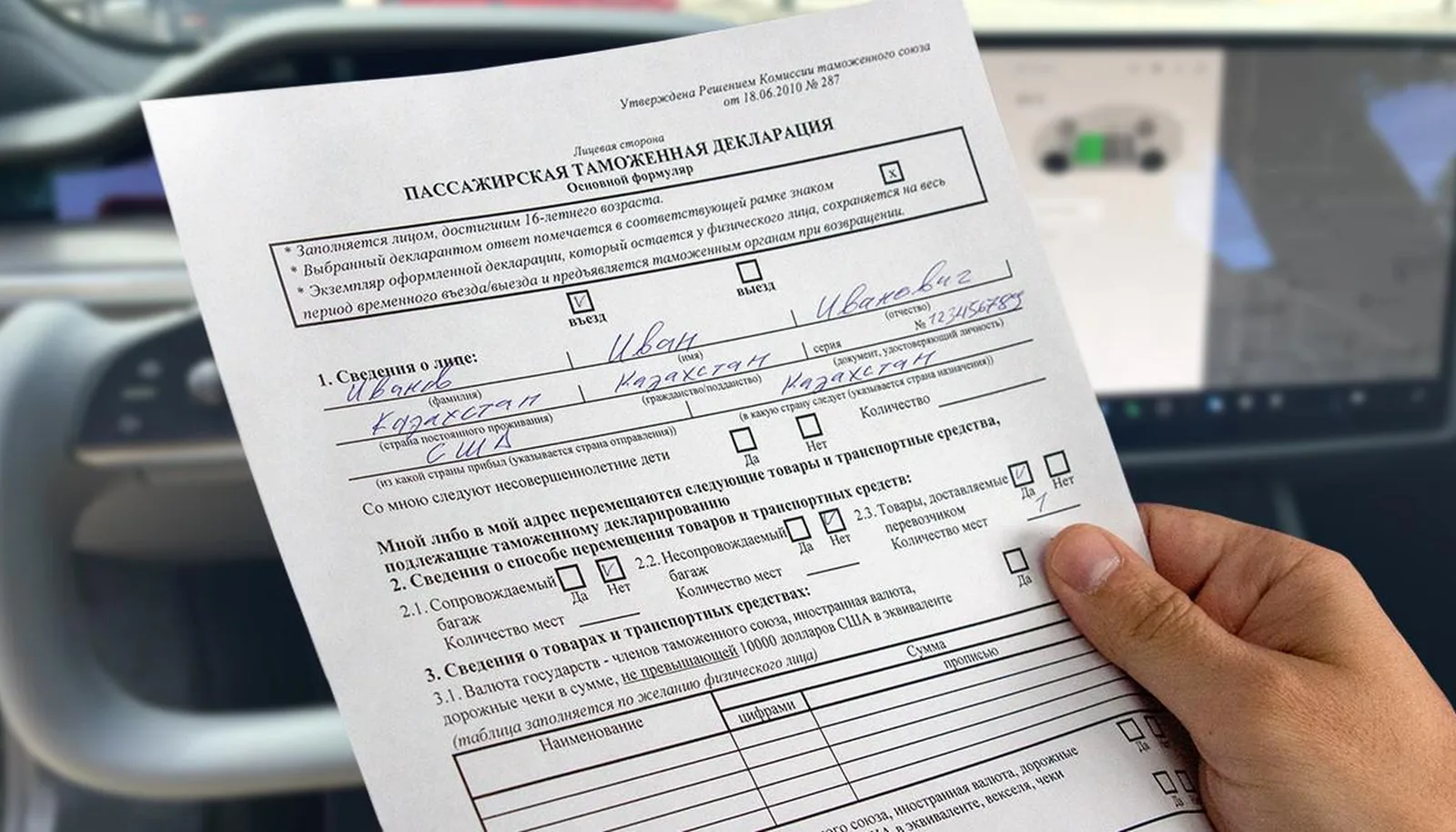
Familiar Pain for Anyone Working with Foreign Economic Activity
Anyone who has ever filled out a customs declaration for goods in Kazakhstan knows the cost of the matter. 54 fields, each with its own format and reference guide. Field 22 requires the invoice currency, field 23 — the exchange rate on the registration date, field 31 — a correct description of the goods, field 33 — a ten-digit code of the EAEU HS, field 36 — preferences, field 42 — the invoice value, field 45 — the customs value, field 47 — calculation of duties, VAT, excise, and customs fees. And all of this must align with each other down to the last tiyn.
An importer, foreign economic activity manager, or customs broker working with the Astana-1 system follows the same route: manually transferring data from the invoice, searching for the appropriate HS code, clarifying the exchange rate from the National Bank of Kazakhstan, calculating the customs value considering the delivery basis according to Incoterms, calculating the duty, adding VAT, not forgetting the customs fee, exporting XML, and submitting it through Astana-1. One declaration for 5–10 items with average attention takes half a working day. A declaration for 30 items becomes a separate project. An error in the HS code or in the calculation of payments results in overpayment, additional charges, or a potential administrative issue.
We are creating HSCAN — a web service that tries to reduce this routine. Not a "revolution," not "magic," and not a claim to replace an experienced declarant. Just a tool that takes over the rewriting of data from documents, helps with selecting the HS code, calculates payments, and forms a file for submission. The service is currently in active development — some parts work quite well already, while others we continue to refine together with the first users.
What is HSCAN
HSCAN is an online service for preparing customs declarations for Kazakhstan and EAEU countries. The idea is simple: to gather in one window everything that is usually scattered across reference guides, calculators, and Excel files. Uploaded an invoice — saw a filled-out form. Selected Incoterms — the customs value was recalculated. Specified the HS code — duties and VAT were calculated. Clicked "export XML" — got a file that can then be submitted through Astana-1.
HSCAN does nothing that a declarant cannot do themselves — it merely saves time on mechanical work and helps not to miss obvious details. The final control and decisions remain with the person: you see all the numbers, formulas, rates, and warnings, and you can double-check and adjust.
Parsing Commercial Documents: Less Manual Input
The most tedious part of filling out the DT is rewriting data from the invoice and accompanying documents into the declaration. One invoice has several dozen fields: seller, buyer, currency, Incoterms, place of delivery, list of goods with prices, weights, quantities, country of origin. All this needs to be transferred accurately — otherwise, the declaration will not pass verification, or the data will "diverge" from other documents in the package.
HSCAN can automatically parse the main types of documents that accompany a typical foreign economic transaction: commercial invoice, packing list, bill of lading, air waybill, CMR, foreign trade contract, and certificates. Key fields are extracted from them — details of the parties, currency, delivery basis, list of goods with weights and prices, countries of origin. The resulting draft declaration is no longer an empty form but a filled framework where you only need to check the details and adjust if necessary.
We honestly say: parsing documents is a place where the service is still learning. Documents are different: some are formatted according to an ideal template, others are a photo of a crumpled sheet from a warehouse. We usually correctly recognize neat PDFs and well-readable scans. If you come across a non-standard document or we recognized something incorrectly — you always see what exactly is substituted and can correct it in a couple of seconds. Each such case is valuable to us: we continue to teach the system on new formats.
HS Code Selection: Assistance, Not the Final Authority
Finding the correct EAEU HS code is the second most significant pain for a declarant. The code determines the duty rate, licensing requirements, certificate requirements, rules of origin determination. Made a mistake — overpaid or, conversely, faced additional charges. Meanwhile, reference guides are cumbersome, formulations are specific, and goods like "Toyota 4Runner," "iPhone 15 Pro," or "Nike Air Max" rarely directly match descriptions in the Unified Customs Tariff.
HSCAN helps with code selection: you enter a description of the goods (you can even include the brand and model), and the service offers several suitable options from the UCT with explanations in Russian and the current duty rate. This is not "the only correct answer" and not a verdict — it is a short list of relevant candidates from which an experienced declarant quickly chooses the right one, and a beginner gets a clear starting point.
We deliberately do not position code selection as "guaranteed correct": product classification is the responsibility of the declarant and often requires analysis of specifics (materials, purpose, method of application). HSCAN narrows the search area and reduces the time for comparison, but the final decision remains with you. If something is not optimally selected for your product niche — we would appreciate feedback to supplement the logic.
Customs Value According to Incoterms: Formulas Without a Calculator
Field 45 — customs value — is a separate headache for everyone working with different delivery bases. EXW requires adding transport, insurance, and loading. FOB/FCA/FAS — add transport from the port and insurance. CFR/CPT — only insurance. CIF/CIP — usually nothing, everything is already included. DAP/DPU/DDP — on the contrary, you can deduct internal transportation within Kazakhstan.
HSCAN knows the basic rules for recalculation according to Incoterms and automatically builds a formula for calculating the customs value from the initial price of the goods, the current exchange rate on the registration date, and delivery parameters. Each calculation is saved with a transparent formula — you see what exactly was added, what was deducted, and why the result is as it is. This is convenient during customs inspection: the declarant can always explain how they arrived at the final figure.
Exchange rates are pulled from an official source — the National Bank of Kazakhstan — and cached so that repeated calculations on the same date do not delay work. If the rate for the required date has not yet been published, the service will honestly inform you and suggest entering the value manually.
Calculation of Duties, VAT, and Fees: Four Blocks of Field 47
The calculation of field 47 is a place where even an experienced declarant can make a mistake, especially when the rates are not the most typical. There are ad valorem ("15%"), specific ("0.3 euros per kg"), combined ("10%, but not less than 0.5 euros per kg"). VAT in Kazakhstan from 2025 is 16% and is calculated from the base "customs value + duty + excise." The customs fee depends on the value in euros and is taken from a scale. Preferences according to field 36 are a separate story: EAEU, CIS countries, Least Developed Countries, the presence or absence of a certificate of origin — all this affects the final duty.
HSCAN calculates four blocks of payments according to standard rules: import customs duty, excise (for excisable goods), VAT, and customs fee. Each line is accompanied by a justification: what rate is applied, to what base, with what preference coefficient. If something is missing for the calculation (for example, the weight of the goods for a specific rate) — you will see a clear warning, not silently receive zero. If the rate could not be unambiguously determined for the selected HS code — the service will also inform you so that you can double-check manually.
We continue to refine the processing of non-trivial cases — combined rates, separate categories of excisable goods, preferences for specific certificates. If your scenario goes beyond the typical — we recommend double-checking the calculation and sharing the case: this helps to quickly close the remaining gaps.
Checking the Declaration Before Submission
Before the declaration is sent to Astana-1, HSCAN runs it through a check. The service looks at the mandatory fields of the header, checks each item for the presence of a description, a sufficiently long HS code, gross and net weights, prices, and calculated customs value. It checks that the net is not greater than the gross. It checks that the sum of the prices of the goods plus transport and insurance from the customs value positions matches the total amount on the invoice with a reasonable tolerance.
All remarks are divided into blocking (without them, submission is not possible) and warnings (can be submitted, but should be double-checked). This does not replace a careful review of the declaration before sending, but helps catch obvious details that would otherwise turn into a refusal or additional request from customs.
Preparing a File for Astana-1, PDF, and Excel
The final step is preparing the declaration in a form suitable for submission through Astana-1. Parallel support is provided for export to PDF (for paper archive and internal company approval) and to Excel (for internal registers and reconciliation with accounting). All formats are generated from the same verified declaration — data does not diverge between documents.
Here it is worth clarifying: the submission of the declaration to Astana-1 is your step. HSCAN prepares the file according to the required structure, but uploading and signing with an electronic signature occurs on the declarant's side in Astana-1 itself. We focus on ensuring the file reaches submission without surprises.
For Brokers and Teams: Collaborative Work
HSCAN was initially designed not only for individual importers but also for customs brokers and foreign economic activity departments of large companies. The service has a multi-user mode: you can set up a company, add declarants, divide declarations among managers, save frequently repeated details and product data so as not to fill in the same thing over and over again. We continue to develop this block based on the requests of the first clients.
Who HSCAN Can Be Useful for Right Now
The service is suitable for different usage scenarios, although we are currently working as closely as possible with those who are ready to be early users and share feedback.
For importers who fill out declarations themselves without a broker, HSCAN saves hours of work and removes dependence on one "irreplaceable" declarant in the team. For foreign economic activity managers of manufacturing and trading companies — it is a centralized place where documents for deliveries are collected and payments are calculated. For customs brokers and small agencies — a tool that speeds up the processing of standard declarations, leaving experts time for complex cases. For small businesses and individual entrepreneurs who import several times a year — the opportunity to prepare a declaration independently without deep immersion in nuances.
If your business is heavily tied to non-standard goods, complex preferences, or rare supply schemes — we would be especially grateful for feedback. Such cases allow us to carefully build up the service.
Honest Status: Service in Active Development
We deliberately do not call HSCAN a "ready-made solution" or "full automation of foreign economic activity." The service continues to evolve. In some areas, document recognition works perfectly, in others — adjustments are needed. In some areas, the duty calculation completely matches what an experienced declarant would calculate, in others — manual adjustment may be required. We understand this and structure the work so that any result can be quickly checked and corrected without losing data.
Therefore, if you try HSCAN — treat it as an assistant that takes routine off your hands, not as a system that can be blindly trusted to send a declaration to Astana-1. The final control remains with the person — this is not a limitation but a conscious position: the responsibility for the correctness of the DT always lies with the declarant, and our task is to facilitate this work, not replace it.
If the service helped you — it is important for us to know. If something was recognized incorrectly, the rate did not match, the form did not accept the data — it is even more important for us to know. Any feedback from real users helps HSCAN improve faster. At this stage, we are ready to be especially responsive to your requests and cases.
What HSCAN Ultimately Provides
If we sum up the practical benefits in one phrase — HSCAN reduces the time spent on the mechanical part of preparing a customs declaration in Kazakhstan. Less manual rewriting of invoices, less time searching for the HS code, less arithmetic on field 47, less fuss with Incoterms and exchange rates. The freed-up time is spent by the declarant on what they should be doing — checking, making decisions, working with complex cases.
We do not promise "zero errors" and "full automation" — that would be unfair to both you and the complexity of the work itself. We promise to work on the service every day, listen to feedback, and gradually close those gaps that still require manual intervention.
Try HSCAN
If you import goods into Kazakhstan, work as a broker, or lead a foreign economic activity direction in a company — try HSCAN on one or two of your declarations. Upload a typical invoice, see how accurately the data is pulled, how the customs value and payments are calculated, how the file for Astana-1 is formed. Compare it with how you usually do it — and share with us what you saw.
This is the early access format we need right now: real declarations, real scenarios, real feedback. In return, we respond as quickly as possible to what you see and use your experience to create a service that is convenient to use every day.
Automatic filling of DT for Kazakhstan is the direction we are moving in, and it is important for us to go through this path together with those who work with foreign economic activity in practice.