

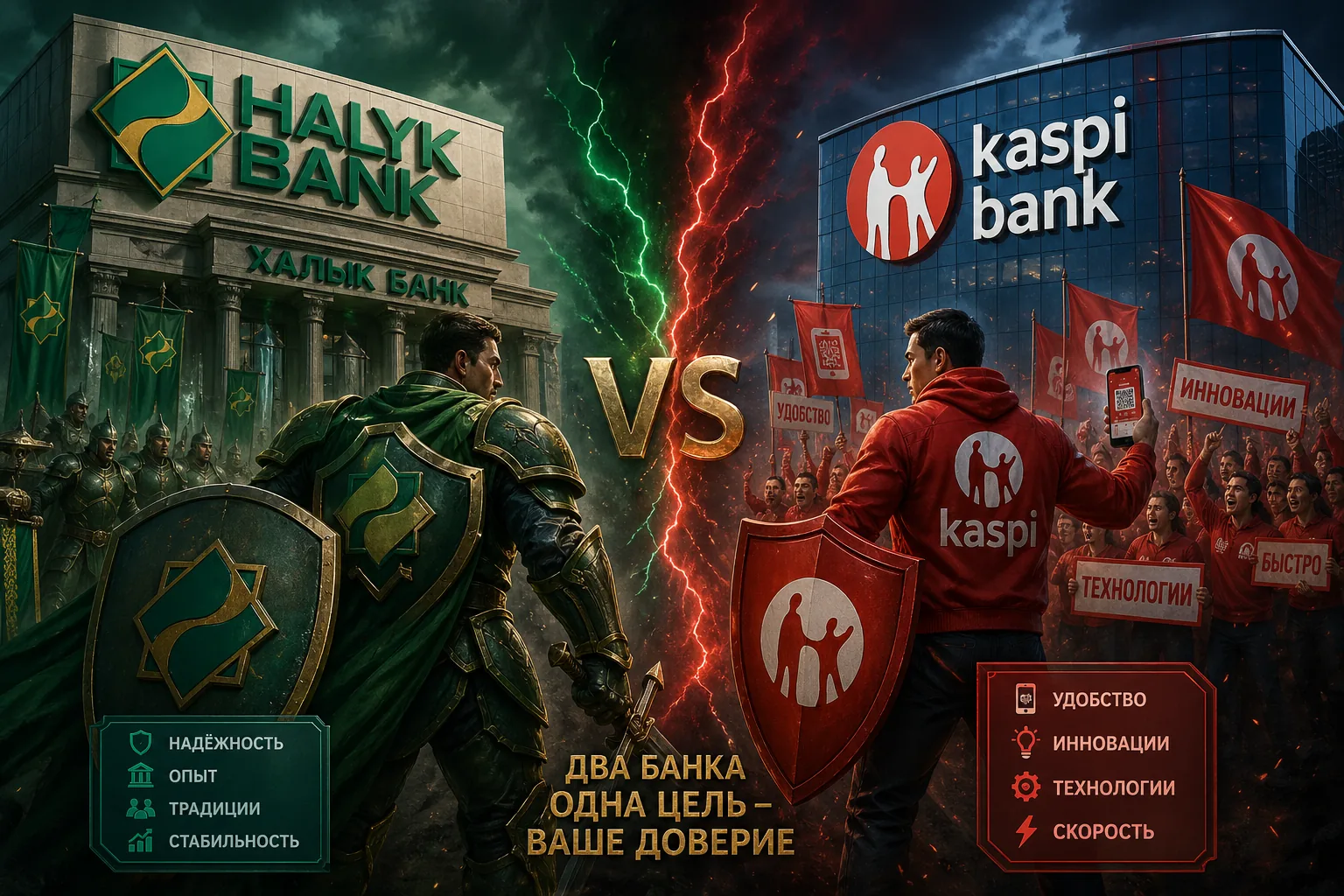
Title: Halyk vs Kaspi: The Quiet War for Kazakhstani Business
Text: In December 2025, Halyk Bank earned 80 billion tenge in net profit in just one month. Kaspi made 53 billion. Together, they account for two-thirds of the entire banking sector's profit in the country. But if you look at another figure, the picture flips: Kaspi.kz's market capitalization on NASDAQ is about $22 billion, while Halyk's on the London Stock Exchange is around $9 billion. One bank earns more. The other is worth almost three times as much. This gap is the main storyline of Kazakhstani fintech over the past ten years—and it directly determines how millions of entrepreneurs in the country live and pay.
We—West Star Ltd—are engaged in integrations with banking and payment APIs, and we see this difference from the inside every day. That's why we decided to understand how the quiet war between these two giants is structured and what conclusions any business owner in Kazakhstan should draw in 2026.
Two Different Businesses Under the Word "Bank"
The first thing to understand is that Halyk and Kaspi are no longer two competing banks. They are two different business models that happened to be in the same regulatory package.
Halyk is a classic universal bank that grew out of a Soviet savings bank from 1923. By the end of 2025, it holds almost 30% of the sector's assets (18.6 trillion tenge), 35.6% of all profits, and 6.1 trillion tenge in corporate deposits. This is infrastructure: loans to large businesses, corporate accounts, acquiring for offline retail, currency operations, correspondent relationships with international banks. Halyk earns on the margin—the difference between the cost of attracting money and the cost of placing it.
Kaspi is a fintech company where the bank is one of the tools, not the essence of the business. When Kaspi is called the "Kazakhstani Alibaba," it's not a marketing stretch but an accurate characterization of the model. Of the 3.6 trillion tenge in revenue for 2025, a significant portion comes not from classic banking interest income but from marketplace commissions, payment services, seller advertising on the platform, and delivery services. Kaspi's average annual revenue growth rate over five years is 41%. These are the growth rates of a tech company, not a bank.
When two businesses with such different models converge in one market, the outcome is predictable: one takes mass transactions, the other—large money. That's exactly what happened.
How One Bank Lost the War for the Wallet
In 2007, the bank named "Kaspiyskiy" changed its leadership. The CEO became 32-year-old Mikhail Lomtadze—a partner at Baring Vostok, a Georgian entrepreneur with an MBA from Harvard, who had never worked in banking before. Vyacheslav Kim, the bank's founder from the 1990s, remained the chairman of the board—a graduate of RFMSH, who started his business in 1993 at the age of 23. They became 50/50 partners and over the next 15 years rewrote the rules of the entire retail market in Kazakhstan.
Lomtadze's key decision was to focus not on the bank but on the consumer experience. In one interview, he formulated it like this: people stand in lines to pay utilities—so online payment needs to be made. People don't understand which loan is beneficial for them—so a solution needs to be made in two minutes in the app. The ideas are on the surface, but to implement them, an engineering team is needed, which classic banks simply didn't have.
Meanwhile, Halyk was going a different route. Until 2001, the People's Bank was state-owned. At the end of 2001, Timur and Dinara Kulibayev (the son-in-law and daughter of the first president) bought 33.3% of the shares for $41 million—a deal that the Asset Recovery Fund would call "significantly undervalued" 20 years later. In 2006, they sold 20.21% of these shares for $748 million, an 18-fold increase in value over five years. After the January events of 2022, some of the Kulibayevs' assets came under investigation, and in November 2025, the Kulibayevs' ALMEX holding sold 7.6% of Halyk shares in an SPO for $475 million, reducing their stake to 62%. The controlling stake remained with the family. The bank has been managed since 2009 by Umut Shayakhmetova—the only female CEO of a bank of this scale in the region.
Halyk's strategy all these years has been clear and cautious: remain the largest, serve corporates, gradually digitalize. This strategy worked—and continues to work in terms of profit. But while Halyk optimized the balance, Kaspi captured the consumer's wallet. And along with the consumer's wallet, Kaspi gained access to small and medium-sized businesses because any Kazakhstani entrepreneur today is primarily someone's app on a client's smartphone.
Where Exactly Kaspi Overtook Halyk
In 2024, Kaspi went public on NASDAQ—the first Kazakhstani listing on an American exchange. This gave the company a valuation unavailable to any other business in the country. By the end of 2025, Kaspi's revenue was 3.6 trillion tenge, net profit—1.1 trillion (according to IFRS financial statements). Halyk, by comparison, earned 976.9 billion tenge in net profit—more than Kaspi in absolute terms, but with revenue several times less. This means that Halyk is effective as a financial machine, but Kaspi generates a significantly larger volume of business with comparable margins.
Where is this directly visible to the entrepreneur? In three places.
First—payment acceptance. Kaspi Pay has become the de facto standard for retail and services. The Kaspi QR code hangs in every taxi, cafe, at the cash registers of most stores. When a client is used to paying with one tap through one app, retraining them is more expensive than adapting. Halyk is trying to respond through its acquiring and partnership with re:Kassa, signed in 2025, but breaking the habit of millions of consumers is not yet possible.
Second—consumer lending, which for business means "how the client finances the purchase." Kaspi Red and 0-0-12 lending on Kaspi Store have turned installment plans into a mass tool. Any seller connected to Kaspi Store automatically gets access to this infrastructure. Halyk is catching up in this area—and against the backdrop of slowing consumer lending growth in the country (from 33.5% in 2024 to 21% in 2025, according to ARRFR), both players face a tougher fight for quality borrowers.
Third—government services. Here, Halyk paradoxically leads. The bank's mobile app integrates more than 66 government services—more than any other bank. Through the Halyk Govtech platform, Kazakhstani citizens received over 50 million services. This is a strong trump card: every trip for a certificate, fine payment, or tax declaration is a touchpoint with the bank. Kaspi responds with its government integration (including Kaspi Guide and budget payments), but no one has a monopoly, and the war in this segment is ongoing.
What This Means for Entrepreneurs in 2026
If you're starting a business in Kazakhstan today, you're effectively choosing not a bank but an ecosystem. And this choice is much more expensive than it seems from the RKO tariffs.
If the business is mass and B2C—a cafe, retail store, hair salon, e-commerce—Kaspi is almost indispensable in terms of acquiring and attracting customers through Kaspi Store. Not because Halyk is technically worse, but because the client is already in Kaspi and doesn't want to switch. The cost of leaving is the loss of traffic. On the other hand, Kaspi takes a marketplace commission (usually 5–15% depending on the category), and this is no longer a banking tariff but the margin of a sales channel.
If the business is B2B, export-import, works with large contracts, or has currency operations—Halyk is stronger in corporate services. It has a deeper loan portfolio for legal entities, a wider network of currency correspondents, more experience in trade finance. Corporate deposits in Halyk are 6.1 trillion tenge versus 887 billion in Kaspi. This is not accidental: large businesses historically go where there is infrastructure and a history of relationships with the regulator.
If the business is technological and API-dependent—both ecosystems have opened part of their interfaces, but neither provides public documentation at the level of, for example, Stripe or Tinkoff. Integrations work through partnership agreements, and access to Kaspi Pay API or Halyk API often becomes a standalone project rather than a one-time setup. This creates a niche for integrators—and at the same time increases the cost for the end business.
The third non-obvious point—taxes and accounting automation. In 2025, Halyk launched Tax Advisor jointly with the KGD: a service that recommends a tax regime for the type of activity and advises on available state support measures. Kaspi responds with its accounting integrations for self-employed and individual entrepreneurs. Against the backdrop of the new Tax Code of 2026, changing the VAT threshold to 10,000 MRP, and increased accounting requirements, this becomes not a "perk" but a real saving of accounting hours.
Where Both Models Are Vulnerable
Any analysis without a section on risks is marketing, not analysis. Both players have weak spots that entrepreneurs should keep in mind.
Kaspi's main risk is concentration. When 70%+ of retail payments go through one ecosystem, any failure paralyzes not a single store but an entire country. In August 2024, Kaspi already faced a multi-hour outage, after which thousands of businesses could not accept payments. Regulatory pressure is also growing: listing on NASDAQ means compliance with American transparency requirements, and any geopolitical shift or sanctions risk instantly reflects on the stock price. Moreover, the history of Kaspi's shareholder capital (including the participation of Nazarbayev's nephew Kairat Satybaldy, who sold his stake in 2018, and investigations conducted after 2022) is a legal background that remains part of the company's corporate biography.
Halyk's risk is the opposite—institutional inertia. A bank with a 100-year history and state heritage changes slower than the market. AI products and Halyk OIY Tech—a conference the bank held for the first time in October 2025, gathering 600+ participants—show that Halyk has realized the technological gap. But between "realize" and "close" in a bank of this size usually takes 3–5 years. During this time, Kaspi is entering Uzbekistan and other Central Asian countries, while Halyk, through Tenge Bank and a deal with Click, is trying to respond in kind. Who will close the regional expansion faster is still an open question.
And there is a common risk for both that is talked about the least: data. Since 2025, mandatory biometrics for online loans have been introduced in Kazakhstan, and the regulator is increasingly demanding transparency from banks on leaks. Both players have had incidents with customer data; for both, this topic is not closed. For an entrepreneur, this means a simple thing: your customer data passing through any banking API is not only your asset but also your risk.
Who Will Win the Next Five Years
The direct answer is no one. This is not a war where one wins. Halyk and Kaspi serve different layers of the same economy, and in the foreseeable years, their shares will continue to grow in parallel. The combined profit of the banking sector in 2025 reached almost 3 trillion tenge, and both giants grew on this growth.
A much more interesting question is who will take the space between them. Bank CenterCredit in 2025 grew its profit 2.5 times. Alatau City Bank, Bereke (bought by Qatar's Lesha Bank), Freedom, Forte—all are looking for their niche. Bank CenterCredit increased corporate deposits by 26% in just one year of 2025—more than Halyk in absolute terms. If you're an entrepreneur choosing a bank today, it makes sense to look not only at the two leaders but also at second-tier banks: their tariffs are more aggressive, decision-making speed is higher, and access to top management is real, not theoretical.
The main conclusion from this whole story is simple and unpleasant. In Kazakhstan in 2026, your bank is not a place where money lies. It's an operating system through which your business passes. Choosing it, you choose not the deposit rate but the infrastructure of the next ten years: who will accept your payments, who will finance your clients, who will integrate with your 1C, and who will update the API quarterly, not once every three years.
And in this logic, the question "Halyk or Kaspi" ceases to be binary. A savvy business in 2026 often works with both—and with a third bank in addition—because the monopoly of any ecosystem makes you its hostage. And a hostage doesn't grow. A hostage pays.