

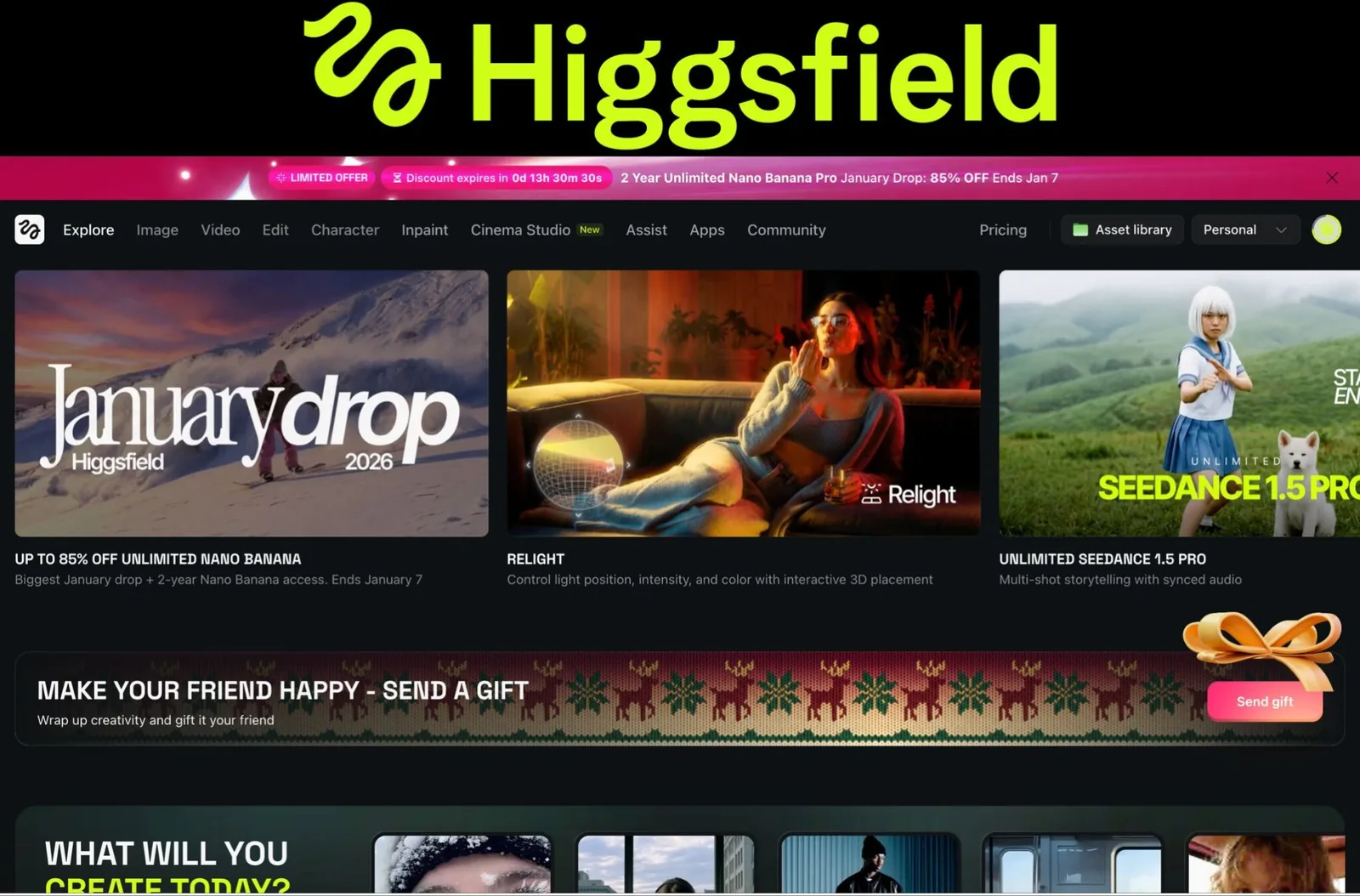
Imagine: you open a browser, paste a product link, choose a style — and within minutes, you have a ready-made advertising video creative at the level of a Hollywood studio. No film crew, no actors, no weeks of editing. Just a couple of years ago, this sounded like science fiction. Today, nine out of the ten largest advertising agencies in the world operate this way. And the company that made it possible has a strange name — Higgsfield. Its co-founder grew up in Kazakhstan.
This is the story of how three people turned an idea into a business valued at $1.3 billion in 11 months. The story of how Kazakhstan finally got its first tech unicorn. And the story of how, in the era of generative AI, speed is everything.
From Programming Olympiads to Snapchat
The main face of the company is Alex Mashrabov, CEO and co-founder of Higgsfield AI. His journey begins not in Silicon Valley, but at a school desk with competitive programming tasks. Mashrabov was in the top 3 in the world at the ACM ICPC international competitions — a tournament considered the Olympics of algorithms in the IT community. There, at the Olympiads, he met people who later formed the core of his future teams.
After university, Alex went to work at Yandex, where he dealt with machine translation systems even before the world believed in neural networks. It was 2014–2016 — an era when the phrase "artificial intelligence" in a resume elicited more ridicule than interest from most recruiters. But it was during these years that Mashrabov formulated a conviction that defined his entire career: the future of media is pixels generated by artificial intelligence. Not filmed, not edited, but fully created by machines.
In 2018, Alex, along with Viktor Shaburov, founded AI Factory — a startup developing face generation and AR effects technologies. The product caught the attention of Snap Inc., the parent company of Snapchat. In 2020, Snap bought AI Factory for $166 million. Mashrabov stayed at Snap and led the generative AI direction, where he launched the My AI chatbot, used by over 150 million people, and a series of viral AR effects that boosted Snapchat's daily audience growth.
It seemed like the peak of his career. But in September 2023, Alex left Snap.
The Moment Higgsfield Was Born
His departure coincided with a tectonic shift in the industry. ChatGPT had already taken the world by storm, Midjourney was drawing pictures better than most illustrators, and generative video remained the last unconquered fortress. Mashrabov understood: whoever takes this fortress first will hold the key to an entirely new market.
In October 2023, together with Kazakh ML researcher Yerzat Dulat and American entrepreneur Mahi de Silva, he founded Higgsfield AI. The name is a reference to the Higgs field from particle physics: an invisible but all-pervading medium that gives mass to everything. The founders intended their platform to become such an invisible infrastructure, but for all video content on the internet.
Yerzat Dulat took on the role of CTO and became, according to Mashrabov, "the best CTO one could dream of." He helped scale Higgsfield from zero to a $300 million annual run-rate in the first year. Mahi de Silva initially joined as an advisor but became involved in every key decision, eventually becoming the third co-founder and Chief Strategy Officer.
In December 2023, the company signed its first term sheet — the seed round was led by Menlo Ventures, the same fund that invested in Anthropic (creators of Claude). What followed was a race that the AI industry already calls one of the fastest ascents in history.
Click-to-Video: Revolution Without "Prompting"
The main thing Higgsfield did was kill "prompting." Competitors like Runway, Pika, and others forced users to write long text descriptions and spend hours selecting the right words for the neural network to produce something decent. Mashrabov and his team took a different path. They created the Click-to-Video category: the user selects a ready-made preset — "cinematic camera flyover," "explosion in the background," "slow motion" — and with one click gets a ready-made clip at the level of a commercial.
Under the hood, Higgsfield combines its own models with the best third-party ones — Google Veo 3, Kling, Nano Banana, and others. This is a deliberate strategy: instead of spending years training one giant foundation model from scratch, the team builds an "orchestrator" that selects the right model for each task. The result is predictable quality at minimal inference cost. As Mashrabov himself said, it's "like having a VFX studio at a hotkey."
By May 2025, revenue was $11 million in annual run-rate. By November of the same year, it was already $100 million, a ninefold increase in six months. In September 2025, the company officially crossed the $1 billion valuation mark and became Kazakhstan's first unicorn. By January 2026, Higgsfield raised a Series A of $130 million at a $1.3 billion valuation, and revenue reached $200 million in annual run-rate — growth rates outpaced Lovable, Cursor, OpenAI, Slack, and Zoom at comparable stages.
Kazakhstan's First Unicorn
For Kazakhstan's tech ecosystem, Higgsfield is not just a startup. It's a symbol. In the previous 15 years, no company from the country had achieved unicorn status. Mashrabov announced the breakthrough on September 28, 2025, at Nazarbayev University in Almaty — and this was done deliberately. The company is registered in San Francisco, but the heart of the engineering team is in Almaty.
In an interview with Sacra, Alex said directly: "I was in the top 3 in the world in competitive programming. And our team has 11 winners of international Olympiads. We deeply respect the potential of people from this region. Kazakhstan itself is home to more than ten consumer unicorns. This gives us a high concentration of talent hungry to create global products."
This strategy — "regional brains plus global play" — fundamentally distinguishes Higgsfield from most Central Asian startups, which traditionally get stuck at the local level. Mashrabov used Kazakhstan's engineering school as a competitive advantage: talent that costs three times more in the Valley is available, motivated, and loyal here. Meanwhile, the headquarters, investors, and main clients are in the US, giving the company access to premium capital and premium revenue.
Who Pays for the Future of Video
Today, Higgsfield is used by nine of the world's top 10 advertising agencies. Among the clients are brands with marketing budgets over $100 million, which transfer up to 90% of their advertising creatives to AI generation. The platform has been mastered by actors, musicians, and independent creators — for example, Misha Fedoseev (@3.14f), who gained 100,000 followers in three months and received an order for the official teaser of the SS26 collection of the Italian luxury brand GCDS in Milan. Working alone. Through Higgsfield.
The company launched Marketing Studio — a unified workflow from a product link to a finished ad. Insert the URL, choose one of nine styles (UGC review, unboxing, virtual try-on, TV spot, and others), get a video. According to Stanford AI Index 2026, generative AI is spreading faster than PCs or the internet in their time: 88% of organizations have already implemented it, and marketing teams are recording a 50% increase in content volumes. Higgsfield found itself in the right place at the right time.
Lessons for Entrepreneurs from Our Region
The story of Higgsfield is a few tough lessons for anyone building a business from Kazakhstan or neighboring countries.
First: global market from the start. Mashrabov didn't try to conquer the CIS first. He aimed for the world league from day one, and that's why he was able to attract Menlo Ventures.
Second: execution speed is more important than product perfection. Alex constantly repeats: "In GenAI, speed is everything. It doesn't matter when you started. What matters is how fast you're moving today." Higgsfield releases new features weekly, and on Saturdays rolls out "silent" UI/UX updates that don't hit social media.
Third: a team of Olympiad winners. Mashrabov deliberately gathered people who can solve non-trivial tasks faster than competitors. This is not a fad, but a tool: in the AI race, those with shorter engineering iterations win.
Fourth: don't be afraid to combine. Higgsfield doesn't try to build the best model in the world. They take the best models and build a product on top of them that solves a specific pain — creating commercial video for social media. This is a lesson for anyone wanting to use AI: the value is not in training your own LLM, but in finding a pain point and addressing it.
Fifth: a culture where a co-founder started as an advisor. Mahi de Silva came in as a mentor but ended up in every important room and eventually became the third co-founder. This is a reminder that the right relationships with people are more important than formal structures.
What's Next
Mashrabov does not hide his ambitions. In an interview with Sacra, he said: "In five years, by the end of the decade, we expect that most of the content on social networks will be generated by AI. And most of that content will be created in Higgsfield." The company's goal is to become a sustainable business worth $100 billion. For comparison: this is a capitalization comparable to Adobe at its peak.
Whether this level will be reached, time will tell. Competition in generative video is becoming fiercer: OpenAI with Sora, Google with Veo, Chinese ByteDance and Kuaishou — all are investing billions. But Higgsfield has already proven one important thing: the Kazakh engineering school is capable of producing a company cited by Forbes, TechCrunch, and Bloomberg. The country's first unicorn was born not in raw materials, not in fintech, and not in logistics. It was born where most did not expect — at the intersection of physics, programming, and visual storytelling.
And perhaps most importantly: Higgsfield has shown that geographic origin is no longer a limitation. In an era where code is written in the cloud, the investor is in Zoom, and the client is anywhere in the world, the question "where are you from?" has finally given way to "how fast are you moving?"
Alex Mashrabov, Yerzat Dulat, and Mahi de Silva are moving fast. Very fast. And while the rest of the world debates whether AI will replace creatives, they are already building the infrastructure where this question sounds rhetorical.