

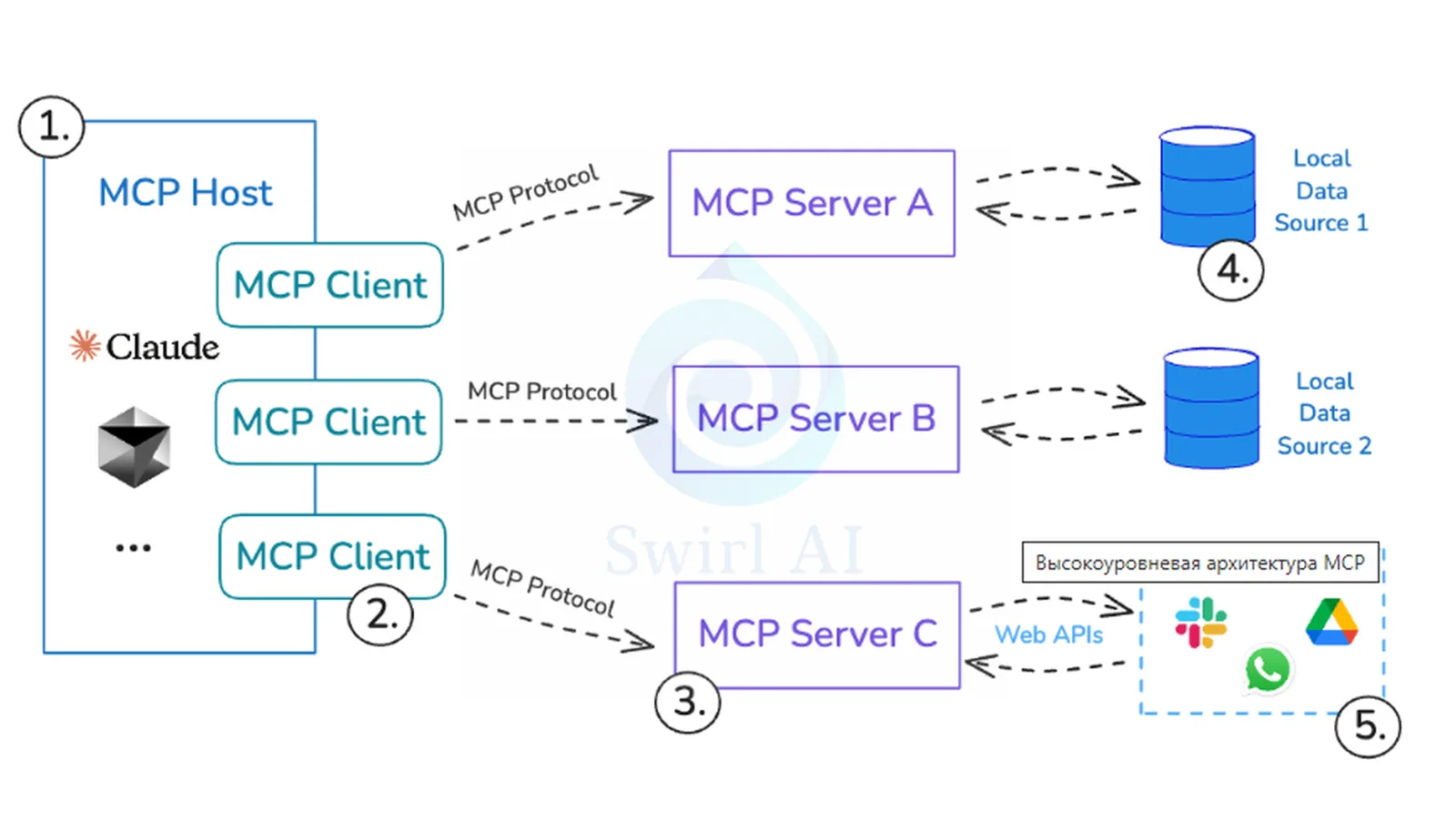
MCP Protocol Comes to Kazakhstan — Why It Matters
In April 2026, a quiet moment occurred that will be remembered as pivotal two years later. According to DigitalApplied, 78% of corporate AI teams worldwide have launched at least one agent in production operating through the Model Context Protocol. 67% of technical directors have named MCP the default standard for integrating AI agents with corporate systems. Competing protocols — A2A from Google, ACP, UCP — gathered 23%, 8%, and 4%, respectively. This is no longer a battle for the standard. It is an established standard.
Background numbers: in April 2026, more than 9,400 servers were registered in the public MCP registry — 7.8 times more than in the first quarter of 2025. The monthly number of SDK downloads exceeded 97 million. Anthropic, OpenAI, Google, Microsoft, JetBrains, Cursor, Windsurf, Zed, Vercel — all leading platforms for developing AI agents either natively support MCP or have integrated it into their products over the past 12 months. Gartner predicts that by the end of 2026, 40% of corporate SaaS applications will include task-specific AI agents, whereas today this figure is less than 5%.
At West Star Ltd, we have been following this topic since its inception in November 2024 because MCP is directly related to our products — AI Accountant, OData Hub, integrations with 1C. Today, it is already clear: companies with a proper API layer over their data will gain a huge competitive advantage in a few months. Those who don't have it will learn about the existence of MCP around the same time when competitors talk about it at an industry conference in 2027. In Kazakhstan, this wave is just beginning, and understanding what is happening is already an advantage.
WHAT IS MCP IN ONE PARAGRAPH
Model Context Protocol is an open protocol developed by Anthropic in November 2024 and quickly supported by other major industry players. Essentially, it is a standardized way for an AI model to connect to external tools and data sources. Before MCP, each AI connection to a corporate system required writing its own connector, data formats, and authentication methods. With MCP, there is a single standard: you write an MCP server over your system once, and any client (Claude, ChatGPT, Gemini, agents in Cursor or GitHub Copilot) can work with it without modification. This idea is often compared to USB-C for electronics: one connector that does it all.
Technically, MCP is a specification over JSON-RPC 2.0. An MCP server describes its capabilities (tools — functions that the agent can invoke; resources — data it can read; prompts — interaction templates). An MCP client invokes these capabilities on behalf of the user. Authentication in the current specification (November 2025) is via OAuth 2.1 and SAML/OIDC, allowing MCP to be integrated into corporate systems with Okta, Azure AD, and other identity providers.
WHY THIS IS THE NEXT BIG WAVE FOR CORPORATE INTEGRATIONS
To understand how seriously this changes the landscape, it's helpful to look at the problem MCP solves. Any medium-sized Kazakhstani company today works with a dozen corporate systems: 1C for accounting, a separate CRM (Bitrix24, AmoCRM, Pipedrive), Kaspi or Halyk bank-client, IS ESF, corporate messenger, document disk, BI analytics. For an AI agent to do something useful in such a company, it needs access to all these systems. Before MCP, this meant a separate integration for each "AI ↔ system" pair. Ten systems, two models — twenty integrations.
With MCP, the logic flips. Each system exposes one MCP server. Each model uses one MCP client. And any model can work with any system without special connectors. Ten systems mean ten MCP servers. Two models mean twelve entities instead of twenty, and it scales linearly, not quadratically.
For Kazakhstani businesses, this shift is becoming practical right now. Several examples that cease to be exotic in 2026.
First — the owner's financial assistant. Connect the MCP server to 1C via OData, to the Kaspi Pay bank-client, to IS ESF. Claude or ChatGPT with these connections answers the question "how much did we pay this contractor for the quarter, do we have overdue receivables from client N, has payment been received for invoice 234" in two minutes. Previously, this was an hour of an accountant's work. Now — seconds of conversation with AI.
Second — an operational agent for a manufacturing company. MCP servers over 1C, over the warehouse accounting system, over ERP. A sales manager asks: "do we have 5 tons of A500C 12 mm rebar in stock, and when can we ship to the Almaty warehouse." The agent checks stocks, reserves, logistics windows, and responds with a specific date. No need to call the warehouse, logistics, and production.
Third — an internal HR agent. MCP servers over the personnel accounting system, over Slack/Telegram, over the calendar, over the corporate wiki. An employee asks: "how to apply for leave from June 15 for two weeks." The agent checks accumulated days, agrees with the manager through a bot, and forms an application in the personnel system. Action time — three minutes instead of two days.
Fourth — tech support with context access. MCP servers over Jira/YouTrack, over the knowledge base, over system logs. An AI agent, when contacted by a client, immediately sees the entire history of their tickets, their installation configuration, the latest errors in the logs — and offers a solution, not asking "please describe the problem."
WHY MCP CONSISTENTLY WON OVER ALL ALTERNATIVES
A year ago, there were still doubts here. Google promoted its own A2A protocol for communication between agents. Microsoft considered Semantic Kernel as an alternative approach. IBM presented ACP. By April 2026, it became clear that MCP wins for a simple reason: it solved the "cheap and fast integration" problem earlier than anyone else.
A2A is about communication between already existing agents, which implies the presence of the agents themselves and investments in their development. MCP is about connecting the model to data and tools, which is needed at the very first step. ACP, UCP, Semantic Kernel — each with its own data model, its own way of registering tools, its own level of abstraction. MCP took the minimally sufficient solution and quickly became the de facto standard.
In March 2026, when Google officially added MCP to the Gemini API and Vertex AI Agent Builder, the discussion about the winner closed. Now the only question is how quickly the ecosystem will grow and what slots it will free up for those building connectors over their own data.
WHAT THIS MEANS FOR KAZAKHSTANI BUSINESS — PRACTICAL SIDE
Several things become obvious once you stop looking at MCP as just another technical novelty.
Connecting an AI agent to 1C ceases to be an individual project. Before MCP, a company that wanted an "AI assistant accountant reading our 1C database" ordered the development of a separate integration for 2–3 months, with a budget of 2–5 million tenge. After MCP, a universal MCP server is written over the OData endpoint of 1C (a few hundred lines of code, one or two working days), and any model immediately gains access to the data. The cost of connection drops by an order of magnitude.
There is a real opportunity for "AI agents for medium-sized businesses." Before MCP, such scenarios were available only to large companies with an internal development team. The cost of integrating one AI agent with one corporate system made the project economically viable only for companies with a staff of 200 people. With MCP, the same cost decreases by 5–10 times. This opens the market for companies with a staff of 20–50 people, of which there are hundreds of thousands in Kazakhstan.
The significance of the API layer over corporate systems is increasing. Those who already have OData over 1C, REST API over CRM, webhook infrastructure for notifications — write an MCP wrapper in a day and gain instant access to new technology. Those who don't have it — once again enter the "let's first build an API" project. And this is no longer a week or a month, but a serious architectural project.
The landscape of SaaS vendors is changing. Those who place their product's MCP server in the public registry automatically enter the AI agent ecosystem. Those who continue to work only through the classic GUI and REST API will be invisible to agents. Gartner's forecast of 40% of corporate applications with built-in agents by the end of 2026 is not alarmism. This is a specific market shift that is already happening.
WHAT EXACTLY CHANGES IN 2026 — ROADMAP
In the March publication of the MCP team, the official roadmap for 2026 was published. Several points from it are critical for understanding the context.
First — enterprise authentication. Until recently, MCP servers were most often authenticated through simple API keys or basic OAuth. In 2026, full support for OAuth 2.1 with PKCE for browser agents and integration with corporate identity providers via SAML/OIDC is added. This is critical for regulated industries — finance, medicine, the public sector. And this is the barrier that kept Kazakhstani banks and large companies from implementing MCP agents over their systems.
Second — scaling and sessions. The current MCP was created with a focus on local work — one user, one client, one server. In 2026, support for stateful sessions with horizontal scaling is introduced. This will allow for production load — hundreds and thousands of simultaneous users of one MCP server.
Third — verified registry and multi-agent coordination. Currently, the public MCP registry is something like early npm: anything can get there, including malicious servers. In 2026, the official MCP Registry is introduced with publisher authenticity verification, security ratings, and signatures. In parallel, support for multi-agent scenarios appears — one MCP server can act as a tool for another agent, turning the ecosystem into a graph of interacting AI entities.
WHERE MCP HAS REAL WEAK SPOTS
For the sake of objectivity, the new technology has significant limitations that should be known in advance.
Security remains an open question. When an AI agent gains access to a corporate system via MCP, it acts on behalf of the user. If the user has access to all company data, the agent gets it too. Model compromise or prompt injection through input data can lead to a leak. The principle of least privilege for MCP servers works in theory, but in practice, it is often not followed. This requires discipline from the team deploying MCP, and no standard can ensure this discipline automatically.
Performance and cost. An AI agent via MCP makes several sequential calls to the model and API. What used to be one SQL query in 100 milliseconds becomes a "model question — tool call — processing — response" chain in 3–8 seconds. For interactive scenarios, this is normal; for high-frequency operations, it's not. In parallel, each agent call is tokens that cost money: a complex session can cost 0.10–0.50 USD, and at a volume of a thousand users a day, this becomes a budget item.
The maturity of the ecosystem is uneven. Servers for popular systems (GitHub, Slack, Notion, Google Workspace) are polished and battle-ready. Servers for niche or local systems are often in an early state, with bugs and no support. In particular, for Kazakhstani systems (Kaspi API, Halyk API, localized 1C configurations, eGov API), there are currently no ready MCP servers in public registries. They will have to be written independently, and for most Kazakhstani companies, this means turning to an integrator.
Regulatory uncertainty. When an AI agent via MCP reads clients' personal data or trade secrets, the question arises — where is this processed, how is it protected, who is responsible in case of an incident. In Kazakhstan, there are currently no special norms for AI agents and MCP. This means that the company operates in a legal gray area: formally, regulation applies as to regular personal data processing, but the risks are not fully clear. For state enterprises and companies with regulatory oversight, this is often a blocker that will only be removed with legislative clarification.
Dependence on cloud models. Most MCP scenarios in Kazakhstan today are built on cloud models from Anthropic, OpenAI, Google. This means that corporate data goes to servers outside Kazakhstan. For critical infrastructure, this is a blocker. Local models (Llama, Qwen) with acceptable quality for MCP scenarios exist but require separate infrastructure — GPU servers, an MLOps team, support. This is not for medium-sized businesses.
WHAT TO DO — PRACTICAL CONCLUSION
What makes sense for a Kazakhstani company to do in the coming months if this topic seems important.
Conduct an audit of existing API layers. If you already have OData over 1C, REST API over CRM, webhook notifications from main systems — you are ready for MCP. A wrapper is written in a few days, and you can test the first scenarios. If there is no API layer — start with that, not MCP. Without it, any attempt to connect AI agents will turn into expensive development of each integration from scratch.
Choose one specific scenario for a pilot. Not "let's automate everything" — that's a path to failure. One scenario, one team, one success metric. The most typical starting points: an accountant assistant with access to 1C, a manager assistant with access to CRM and product catalog, a tech support assistant with access to Jira/YouTrack and knowledge base.
Consider security from the start, not as an afterthought. A separate user in each system under the MCP server with a minimal set of rights. Audit all requests in logs. Limit the type of operations — for example, only reading, without writing at the first stage. Regular review of access rights.
Do not tie yourself to one model provider. Now Claude, in six months — Gemini, in a year — something new. MCP provides abstraction from the model: the written server works with any client. Use this advantage — do not build the entire architecture under one vendor.
In our products — AI Accountant, OData Hub, warehouse integrations with 1C — we are moving in this direction: each integration layer over Kazakhstani systems is wrapped in an MCP server, which can then be used by any model. This is the investment that seemed excessive in 2024, questionable in 2025, and turns out to be fundamental in 2026. In a year, this norm will become obvious. The main thing is to be inside it before everyone else gets there.