

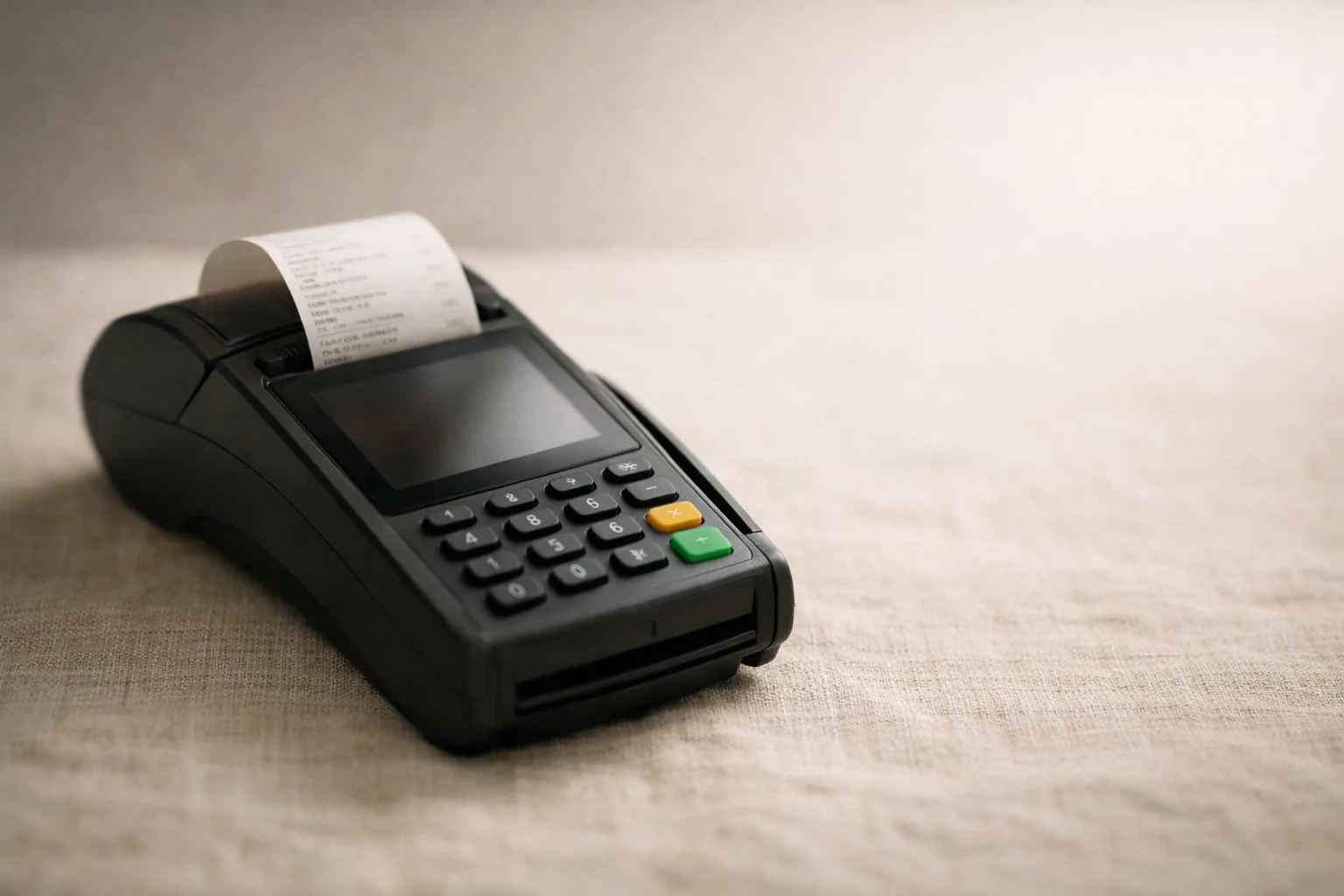
Online Cash Register for Business in Kazakhstan 2026: How to Connect
As of January 1, 2026, a new Tax Code is in effect in Kazakhstan, and the online cash register is once again at the forefront of business attention. The obligation to use a cash register is enshrined in paragraph 1 of Article 110 of Code No. 214-VIII and applies to cash transactions, bank card payments, and mobile payments. Data from each receipt is sent to the fiscal data operator no later than 15 minutes after payment, and a repeated failure to use the cash register within a year can result in a fine for large businesses of up to 50 MCI — that's 216,250 tenge with an MCI of 4,325 tenge. For entrepreneurs, the online cash register has long ceased to be just a "box at the cashier": it is the point where sales, taxes, and accounting converge.
At West Star Ltd, we have been integrating 1C, automating accounting, and processing payments for several years, and most often, clients come to us not for the cash register itself, but to ensure that data from it is not lost between the cashier, accounting, and the website. In this material, we will figure out who really needs an online cash register in 2026, how to connect it through the FDO, what must be included in the fiscal receipt — and where the "hardware" ends and the automation begins, for which everything is undertaken.
Who Needs an Online Cash Register in Kazakhstan in 2026
The basic rule is simple: if you accept money from customers — in cash, by card through a POS terminal, or by mobile payment — you need an online cash register with data transmission. This is a direct requirement of paragraph 1 of Article 110 of the Tax Code, and it does not depend on whether you operate as an individual entrepreneur or a limited liability partnership, under a simplified or general taxation regime.
The list of those who are not required to use a cash register is closed — it is provided in paragraph 2 of Article 110 and does not allow "creative" expansion. It includes:
- individuals who are not entrepreneurs;
- private bailiffs, lawyers, and mediators;
- the National Bank and second-tier banks;
- religious associations;
- the National Postal Operator (with reservations);
- entrepreneurs who conduct transactions through a special mobile application.
Pay attention to two details. First, private notaries are not included in the list of exemptions — unlike lawyers and mediators. Second, the smallest businesses can use a special mobile application instead of a cash register (for example, e-Salyq Business): for micro-format, this is a legal alternative to a "hardware" cash register. A separate case is stipulated when there is no connection at the point: a cash register without data transmission is allowed there (paragraph 3 of Article 110), but this is an exception for remote locations, not a way to save on the FDO.
The fiscal receipt itself in 2026 contains 16 mandatory requisites (paragraph 56 of the Rules for the Use of Cash Registers). Two of them — a link to FDO data for customer verification and a barcode — are mandatory only for online cash registers. Industry-specific requirements have also appeared: for example, a receipt for medical services must now show the recipient's IIN. This may seem trivial at first glance, but it shows a trend — the state is gradually linking each receipt to a specific person and transaction.
Discipline is reinforced by fines under Article 284 of the Administrative Code. The first violation of any kind is a warning, without monetary penalty. However, a repeated violation within a year after the penalty already hits the pocket. For not using a cash register or working with a faulty or unregistered device, small businesses will pay 15 MCI (64,875 tenge), medium businesses 30 MCI (129,750 tenge), and large businesses 50 MCI (216,250 tenge). For not issuing a receipt, the amounts are slightly higher for small businesses — 20 MCI (86,500 tenge). For fiscal data operators, a repeated violation costs 150 MCI. The logic is clear: warned once, further — with a ruble, or rather tenge.
Online Cash Register, FDO, and 1C: How to Connect Everything
The technical chain looks like this. The cash register issues a receipt and immediately sends it to the fiscal data operator — a commercial intermediary organization between the business and the tax authorities. Transmission is allowed no more than 15 minutes from the moment of settlement. If the connection with the FDO is lost, the cash register can operate autonomously, but not for more than 72 hours; after the connection is restored, the accumulated receipts receive a fiscal mark and "reach" the tax authorities. The registration of the online cash register in 2026 is based on FDO data, and cash registers are accounted for in the state ISNA system.
There are several operators on the market, and the choice is not a formality: tariffs, connection stability, and how conveniently you can retrieve data for accounting depend on the FDO. According to the State Revenue Committee, the active FDOs include Kazakhtelecom, Transtelecom, Kar-Tel, Kaspi Bank, Jusan Mobile, "Bukhta.kz," and several others — the current list should always be checked on the Committee's website before connecting. The difference between operators is not only the subscription price: more important is how quickly and in what format you can retrieve receipt data for accounting, and many look at this criterion last, but they shouldn't.
And this is where the most interesting part for business begins. The Tax Code includes the concept of a three-component integrated system (TIS). According to the definition in Article 1, it is a bundle of three elements: a cash register with data recording and transmission functions, a device for accepting non-cash payments, and equipment with a system for automating trade, services, and inventory accounting. Instead of three separate devices, a single software and hardware complex is allowed.
The third component — the automation and accounting system — is exactly the area where we work. The cash register itself records the payment fact but does not keep track of inventory, does not calculate cost, and does not know what happens to the same product on the website or in the warehouse. To avoid manual data transfer, the online cash register is linked to the accounting system — most often with 1C — through integration via OData and API, and payment acceptance and acquiring are integrated into a single circuit along with online payment on the website. As a result, a sale at the cash register automatically writes off the product from the warehouse, enters the accounting system, and is reflected in the online storefront without double entry. How this is arranged on the website side, we discussed in detail in the article on accepting online payments.
An important nuance of 2026: previous tax benefits for using TIS — surcharges to VAT and simplified declaration thresholds — have been canceled, as they were based on the old Tax Code, which is no longer in force. However, the TIS itself has been legally preserved: its requirements are approved by the Ministry of Finance Order No. 606 of October 15, 2025, the model is included in the Unified TIS Register, and the user registers the system with the tax authority within three working days. Therefore, implementing TIS is now worth it for the sake of accounting order, not tax benefits — and this looks more honest from a business perspective.
Limitations and Pitfalls of Online Cash Registers
The online cash register solves exactly one task — the fiscalization of transactions. Everything else expected from it relies on integration and discipline. Here's where most often stumble:
- The cash register does not keep records. The receipt went to the FDO, but the cash register does not calculate inventory, cost, and profit — a separate accounting system and connection to it are needed for this.
- Autonomous mode is limited to 72 hours. For points with unstable internet, a prolonged connection loss with the FDO is a real risk of violations, not theoretical.
- "Out of the box" integration does not always work. Different FDOs and different cash register models provide data differently, and linking with 1C or the website almost always requires setup, not just a checkbox.
- TIS benefits no longer motivate. Previously, the three-component system raised thresholds for VAT and simplified taxation; now this benefit is gone, and the decision about it needs to be made for managerial reasons.
- The human factor has not disappeared. Incorrect amounts, unissued receipts, work "bypassing the cash register" — all this is still fined, and automation reduces the risk but does not eliminate it.
- Industry requirements complicate the receipt. IIN in the receipt for medical services, product labeling, transition to 16% VAT — each new norm adds fields and rules that both the cash register and the accounting system must support.
From this follows a simple practical conclusion, different for different roles. An accounting specialist should clarify in advance with their FDO how to export receipt data and whether they can be imported into 1C without manual transfer. A manager should view the cash register not separately, but as part of the "cash register — payments — accounting — website" bundle and calculate the cost of owning the entire chain. And the owner should remember the main thing: the online cash register is a mandatory condition for operation in 2026, but it only provides real returns when it ceases to be an isolated device and becomes a source of data for the entire business.
Frequently Asked Questions
Do I need an online cash register if I only accept card transfers?
It depends on what exactly these transfers are. A card payment through a POS terminal or by QR code is considered a non-cash transaction with the customer, and a cash register is needed here. However, a transfer from one bank account to another, for example by payment order, does not relate to cash register transactions and does not require a cash register. In practice, the boundary is thin, so it is better to check the specific payment scheme with an accountant.
How is an online cash register different from TIS?
An online cash register is one element: a device or software that records a transaction and sends the receipt to the fiscal data operator. TIS, a three-component integrated system, is a bundle of a cash register, a device for accepting non-cash payments, and an accounting automation system. Simply put, the cash register is responsible for fiscalization, and TIS ensures that the sale is immediately reflected in accounting and payments.
Can an online cash register be linked to 1C and the website?
Yes, and this is usually what it's all about. Receipt data from the FDO or directly from the cash register is entered into the accounting system, most often 1C, and from there it is linked to the website and warehouse, so one sale is reflected immediately in all systems. Then the sale automatically writes off the product and enters the accounting system. There is no ready-made universal solution — the setup depends on the specific cash register, FDO, and accounting system, but technically this is a standard integration task.
What is the penalty for operating without an online cash register in 2026?
The first violation is a warning. For repeated non-use of the cash register within a year, small businesses pay 15 MCI, medium businesses 30 MCI, and large businesses 50 MCI, that is, up to 216,250 tenge with an MCI of 4,325 tenge. For not issuing a receipt, the fine for small businesses is higher — 20 MCI. Therefore, it is cheaper to properly connect the cash register and accounting once than to pay for systematic violations.